JOURNAL OF MARGINALIZED COMMUNITIES AND SOCIAL JUSTICE
A peer-reviewed journal dedicated to Inclusivity, Diversity, and Equity (IDE)
About
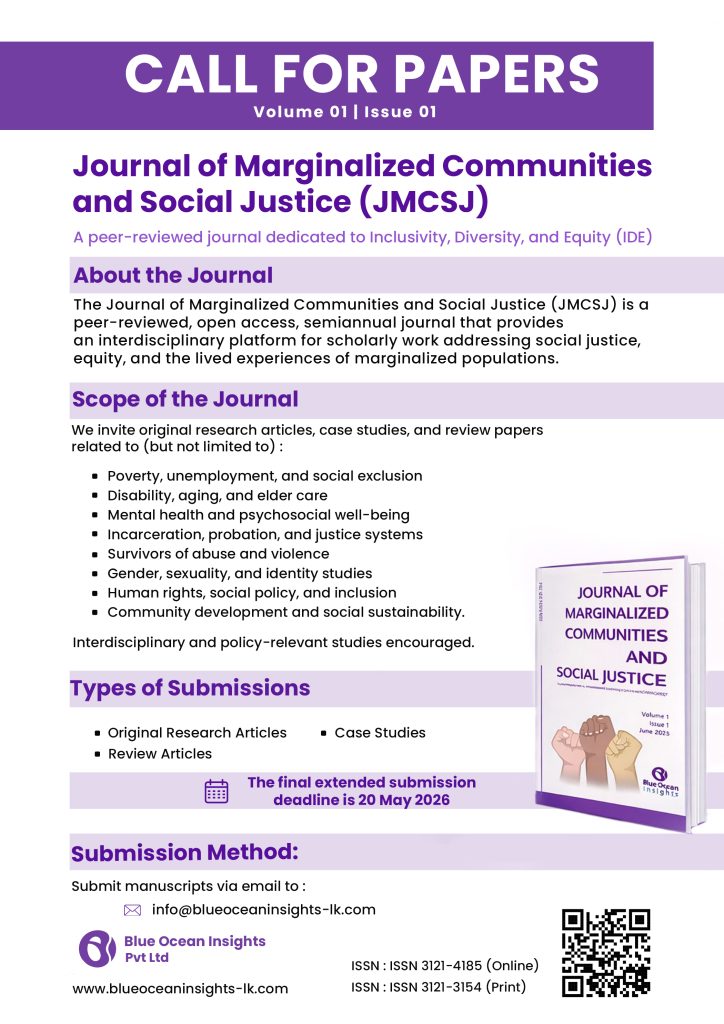
The Journal of Marginalized Communities and Social Justice (JMCSJ) is a peer-reviewed, open access, semiannual publication dedicated to inclusivity, diversity, and social justice. It provides an interdisciplinary platform for original research, case studies, and reviews that address the experiences and challenges of marginalized populations.
The journal’s scope includes communities affected by poverty, unemployment, disability, aging, orphanhood, mental health conditions, incarceration, sexual abuse, and LGBTQ+ identities, among others. JMCSJ seeks to amplify underrepresented voices, promote evidence-based dialogue, and contribute to equitable policy and practice at local and global levels.
By fostering rigorous scholarship and ethical publishing standards, JMCSJ connects researchers, practitioners, and advocates committed to advancing social equity and human dignity.
Aim and Scope of the Journal
The Journal of Marginalized Communities and Social Justice is a peer-reviewed journal dedicated to inclusivity, diversity, and social justice among marginalized populations. Its aim is to advance inclusive scholarship by amplifying underrepresented voices, fostering critical dialogue, and generating knowledge that informs policies and practices addressing social, cultural, and economic inequalities.
The journal provides an academically rigorous and respectful platform for interdisciplinary research that explores the lived realities of individuals and groups who experience exclusion, discrimination, or systemic disadvantage. Its scope includes, but is not limited to, studies on persons living in poverty, unemployed and underemployed populations, single adults, older persons, orphaned or parentless children, persons with disabilities, individuals identifying as LGBTQ+, persons with mental health disorders, incarcerated populations, children in probationary care, and survivors of sexual abuse. Recognizing that marginalization is multidimensional and intersectional, the journal welcomes contributions from a range of disciplines including health, education, psychology, law, criminology, employment, economics, identity, human rights, and social policy.
By embracing inclusivity and diversity, the journal seeks to strengthen scholarly understanding, inspire effective practice, and promote social justice across local and global contexts.
Open Access Policy
The Journal of Marginalized Communities and Social Justice follows an open access model, ensuring that all published content is freely available online without charge. We believe that unrestricted access to research enhances visibility, promotes equity in knowledge sharing, and supports a wider global exchange of ideas that advance scholarship and practice.
Journal History
The Journal of Marginalized Communities and Social Justice (JMCSJ) was established in 2025 by Blue Ocean Insights Pvt Ltd, Sri Lanka. Created to amplify underrepresented voices, it serves as an inclusive academic platform promoting research, dialogue, and policy impact on issues of diversity, equity, and social justice.
Copyright
Articles submitted to JMCSJ must be original, unpublished, and not under review elsewhere. Copyright remains with JMCSJ; reprints require prior permission from the Editorial Team.
ISSN XXXX-XXXX (Print)
E- ISSN XXXX-XXXX (Online)
Journal Sponsorship
Publication Fee
There is no submission and publication fee to publish in the JMCSJ.
Funded and Published by:
Research Department
Blue Ocean Insights Pvt Ltd
Phone +94741813172
Email info@blueoceaninsights-lk.com
Website www.blueoceaninsights-lk.com
LikedIn www.linkedin.com/company/74686553/
Submission Preparation Checklist
Authors submitting manuscripts to the Journal of Marginalized Communities and Social Justice (JMCSJ) are required to ensure that their work complies with the following criteria. Submissions not meeting these standards may be returned for revision before review.
I.Originality: The manuscript is original, has not been published previously, and is not under consideration by another journal. If exceptions apply, these are explained in “Comments to the Editor.”
II.File Format: The manuscript file is submitted in Microsoft Word, WPS Office, or PDF format.
III.Formatting: The text is single-spaced, uses a 12-point font, and applies italics instead of underlining (except for URLs). All figures and tables are inserted within the text at the appropriate locations rather than placed at the end.
IV.Style and References: The manuscript follows the stylistic, formatting, and bibliographic requirements outlined in the Author Guidelines.
V.Peer Review Compliance: For submissions to peer-reviewed sections, the manuscript has been prepared in accordance with the instructions under “Ensuring a Blind Review.”
Author Guidelines
The Journal of Marginalized Communities and Social Justice (JMCSJ) considers the following categories of manuscripts for publication:
Type of Paper
Description
Structure & Requirements
Word Limit
Display Items
Original Article
Empirical studies of scientific quality relevant to the journal’s readership.
Must include an abstract, introduction, methods/approach, results, discussion, and conclusion. Appropriate details should be provided to support conclusions.
Minimum 5,000 words; Maximum 7,500 words (including abstract, text, tables, annexures, and references)
Normally no more than 7 display items (tables/figures).
Case Study
Reports on specific cases (individuals or communities) that are unique, current, and contribute meaningfully to the field.
Should include abstract, introduction, case description/report, and discussion.
Minimum 3,000 words; Maximum 6,000 words.
Not specifically limited, but should be concise and relevant.
Review Article
Critical overviews summarizing and synthesizing current knowledge in a field.
Must include an abstract and main text. Review submissions are considered from reputable authors with a strong track record in the subject area.
Minimum 3,000 words; Maximum 5,000 words (excluding references, tables, and figures).
Flexible, but should support the narrative.
Before You Submit Your Manuscript
Authors are requested to carefully review and comply with the following requirements prior to submission. Manuscripts that do not follow these guidelines may be returned for revision.
1. File Format
- Manuscripts should be submitted in Microsoft Word, WPS Office,or PDF
2. Text Formatting
- Use single spacingthroughout the manuscript.
- Employ a 12-point font(Times New Roman or similar, unless otherwise specified).
- Use italicsfor emphasis instead of underlining (except in URLs).
- Insert all illustrations, figures, and tableswithin the text at the appropriate points, not at the end of the manuscript.
3. Title Page Requirements
The title page must contain the following elements:
- Title: Concise, informative, and free from abbreviations or formulas wherever possible.
- Author Names and Affiliations: Clearly state the first (given) name and family name of each author. Affiliations should be indicated using superscript letters, placed after the author’s name and before the corresponding institution. Each affiliation must include the institution name, country, and the author’s email address.
- Corresponding Author: Identify the author responsible for all correspondence during submission, review, publication, and post-publication. The corresponding author must provide a valid and current email address.
- Authorship Integrity: Only individuals who have made a genuine contribution to the research should be listed as authors. Do not include anyone who has not contributed or does not wish to be associated with the work.
Section | Requirements |
Abstract & Keywords | Every submission must include a clear and factual abstract (maximum 200 words). It should briefly describe the purpose, design/methodology, findings, implications, and originality. Authors must also provide 4–6 keywords related to the paper. |
Headings | Use concise headings to indicate hierarchy clearly. Format: First-level headings in bold, subsequent sub-headings in medium italics. |
Footnotes | Use sparingly and number consecutively throughout the article. Footnotes can be created automatically by-word processors or listed separately at the end of the manuscript. Do not include footnotes in the reference list. |
Figures | Figures (charts, diagrams, drawings, screenshots, or photographs) must be submitted electronically. Acceptable formats: TIFF, JPEG, PNG, EPS, or high-resolution PDF. Ensure correct resolution (minimum 300 dpi). |
Tables | Insert tables within the main body of the manuscript. Number tables consecutively, provide a brief descriptive title, and place any notes directly below the table. |
Mathematical Formula | Submit equations as editable text, not as images. Simple formulae should appear in line with the text, using the solidus (/) for fractions (e.g., X/Y). Variables must be italicized. Use “exp” for powers of e. Number equations consecutively if referenced separately in the text. |
References | All references must follow a recognized APA style format. Authors should consult the APA Referencing Guide: APA Referencing Guide. A manuscript template is also available for download to ensure correct formatting. |
Download JBRI Manuscript Template
Research Data
Authors are encouraged to share supporting data relevant to their research publication, where appropriate. Research data refers to results of observations or experimentation that validate research findings. Data may be interlinked with published articles to enhance transparency and reproducibility.
Acknowledgments, Research Funding, and Authors’ Contributions
All acknowledgments should be placed in a separate section at the end of the manuscript, immediately before the reference list. Authors should not include acknowledgments on the title page, within footnotes, or in any other part of the manuscript. This section should briefly recognize individuals, institutions, or organizations that contributed to the work but who do not meet the criteria for authorship.
Authors must also disclose all sources of research funding. This includes grants, institutional support, sponsorships, or any financial assistance that supported the study. The role of the funding agency should be described clearly, outlining its involvement (if any) in the design of the study, data collection, analysis, interpretation, or the preparation and submission of the manuscript. If the funder had no influence on the study process, this must also be stated explicitly for transparency.
In addition, author contributions must be stated clearly. Each author’s role should be described in detail, using their initials to indicate specific contributions. For example: HNP conducted the field research and drafted the manuscript; MF performed the statistical analysis and contributed to data interpretation; DL coordinated the literature review and assisted with editing. Following this statement, authors must confirm that all contributors have read and approved the final version of the manuscript, and that they agree with the listed order of authorship.
This policy ensures integrity, transparency, and accountability in the publication process, and reflects JMCSJ’s commitment to academic rigor and ethical publishing.
Competing Interests
Authors must clearly state whether any competing interests exist in relation to their submitted work. Competing interests may include financial, personal, or professional relationships that could influence the research. If no conflicts exist, authors should include the following statement:
“The authors declare that they have no competing interests.”
Research and Publication Ethics
The Journal of Marginalized Communities and Social Justice (JMCSJ) is committed to maintaining the highest standards of ethical publishing. All manuscripts submitted to the journal are expected to uphold integrity, transparency, and accountability throughout the research and publication process. JMCSJ has developed clear guidelines on research and publication ethics that apply to authors, reviewers, editors, and readers, ensuring that all contributions are ethically sound and trustworthy.
The journal fully supports the advancement and application of consistent ethical practices within the scholarly publishing community. Authors are strongly encouraged to review our Research and Publication Ethics Guidelines prior to submission to avoid any potential issues. These guidelines provide direction on responsibilities, conflicts of interest, plagiarism, data integrity, authorship, peer review, and corrections or retractions when necessary.
Author Responsibilities
By submitting a manuscript to the Journal of Marginalized Communities and Social Justice (JMCSJ), authors agree to uphold the following responsibilities:
- Originality
All manuscripts must be original and must not have been previously published in the same or a substantially similar form.
- Exclusivity
Submitted work should not be under review or consideration by another journal or publisher at the same time.
- Conflicts of Interest
Any potential conflicts of interest must be declared at submission to allow the editorial team to make an informed decision on the manuscript.
- Use of Third-Party Material
Authors must secure the necessary permissions for any third-party content (such as figures, tables, or text extracts) included in their work.
Written consent must be obtained from individuals or organizations named in the manuscript.
- Legal and Ethical Compliance
Manuscripts must not contain unlawful, defamatory, or unethical statements.
The submission must not infringe upon existing copyrights.
- Authorship Integrity
Authorship should be determined before submission. No individual should be added as an author without contribution (“gifted authorship”) or excluded despite substantial contribution (“ghost authorship”).
Authorship Criteria
To qualify as an author of a manuscript submitted to the Journal of Marginalized Communities and Social Justice (JMCSJ), an individual must meet all of the following conditions:
- Substantial Contribution– made significant input into the conception or design of the study, or into the acquisition, analysis, or interpretation of data.
- Intellectual Engagement– participated in drafting the manuscript or revising it critically for key intellectual content.
- Final Approval– reviewed and approved the final version of the manuscript prior to submission.
- Accountability– accepted responsibility for the accuracy and integrity of the work, ensuring that questions related to any part of the research are appropriately addressed.
Authorship Disputes
Disputes may arise in the following forms:
- Ghost Authorship: Failure to acknowledge a contributor who meets authorship criteria.
- Gift/Guest Authorship: Listing someone who has not contributed meaningfully, or who has chosen not to be associated with the research.
- Order Disputes: Disagreements over the order of authors or the extent of each author’s contribution.
In the event of such disputes, authors are encouraged to contact the Editorial Office of JMCSJ to discuss the appropriate procedures for resolution. The editorial team will work in accordance with ethical publishing guidelines to address the matter fairly.
Informed Consent
To ensure ethical publishing, authors must obtain appropriate permissions before submitting manuscripts that involve named individuals, organizations, or sensitive information.
- Written Consent: If a study refers to a specific person, group, or organization, authors must secure written consent prior to submission.
- Case Studies: Authors must inform the editorial team if their work involves individuals or organizations, and provide documented proof of consent where sensitive details are included.
- Product or Service Reviews: Critiques are welcome but must remain constructive and free of malicious intent.
- Retractions: If any published material is found to contain offensive or defamatory content, JMCSJ will issue a retraction notice, and in some cases, withdraw the article entirely when legally required.
- Pending Permissions: Manuscripts with permissions still pending will not proceed to publication.
Citation Ethics
Proper citation is essential to scholarly integrity. Authors should avoid unethical practices such as:
- Self-Citation: Excessive citation of one’s own previous work to inflate impact.
- Coercive Citation: Including citations at the request of editors or reviewers when they are irrelevant.
- Citation Pushing: Over-citing a specific group, journal, or author for purposes unrelated to the manuscript’s content.
JMCSJ upholds responsible citation practices to maintain the credibility and reliability of published research.
Plagiarism
Plagiarism can take many forms, including verbatim copying, close paraphrasing, reuse of material without proper attribution, text recycling, and self-plagiarism. The Journal of Marginalized Communities and Social Justice (JMCSJ) requires all submissions to be the original work of the authors, clearly expressed in their own words and supported with appropriate citations where relevant. Any failure to acknowledge sources will be considered plagiarism. To maintain academic integrity, JMCSJ uses plagiarism detection software (Turnitin) along with expert evaluation from reviewers and the editorial team. Manuscripts found to contain plagiarism will be rejected or retracted in accordance with ethical guidelines.
Research Integrity Policies
The Journal of Marginalized Communities and Social Justice (JMCSJ) upholds strict standards of research integrity. Authors must adhere to the following principles:
1. Data, Figures, and Images
- Manipulation of data or images is considered a serious breach of research ethics.
- Figures must not be altered beyond minimal adjustments (e.g., brightness, contrast) necessary for clarity.
- Adding, removing, or modifying elements to misrepresent results is prohibited.
- Editors may request original data filesat any time for verification.
- If intentional manipulation is confirmed, the manuscript will be rejected or, if published, retracted.
2. Dual or Simultaneous Submission
- Manuscripts must not be submitted to more than one journal at the same time.
- Authors are expected to await the final decision from JMCSJ before submitting the work elsewhere.
- Breach of this policy may lead to rejection and reporting of misconduct.
3. Attribution and Prior Work
- Authors must properly cite any previous dissemination of their work, including conference papers, abstracts, or extended abstracts.
- Clear attribution ensures transparency and provides a documented history of the research.
- Failure to acknowledge earlier versions may be treated as academic misconduct.
Conflicts of Interest
A conflict of interest arises when authors, reviewers, or editors have interests that are not fully transparent yet may influence their judgment or decision-making in the publication process. To maintain integrity and trust, all parties involved in submission and review are required to disclose any potential conflicts of interest.
For authors, conflicts may include, but are not limited to:
- Previous personal or professional relationships with editors or reviewers.
- Financial or personal interests that could affect research outcomes.
- Undisclosed financial sponsorship or funding from third parties with vested interests.
- Financial or personal motives to suppress or influence research findings.
- Pending patents or intellectual property related to the submitted work.
When submitting a manuscript, authors must provide a declaration outlining any third-party funding and clearly identifying other possible conflicts of interest.
If an editor or reviewer is found to have a conflict of interest regarding a submission, they will be removed from handling that manuscript. Authors who suspect potential conflicts in the review process should contact the Chief Editors of JMCSJ immediately.
This policy ensures transparency, fairness, and impartiality in the editorial and peer-review processes.
Journal Management and Visibility
The Journal of Marginalized Communities and Social Justice (JMCSJ) is managed using [Journal Management System/Software – details to be inserted here]. This platform provides a reliable and transparent workflow for manuscript submission, peer review, editorial decision-making, and publication. The system is designed to support open access publishing and complies with international standards for academic journal management.
To enhance the visibility and impact of published research, JMCSJ strongly encourages authors to engage in post-publication dissemination. Authors may share their work through recognized academic networking platforms such as ResearchGate and Academia.edu, as well as institutional repositories, in accordance with the journal’s licensing policy [license details to be inserted here].
For further inquiries regarding our publication ethics policies or journal management practices, authors are welcome to contact the editorial office at: [Insert Contact Email Here].
Third-Party Copyright Permissions
Before submitting a manuscript to the Journal of Marginalized Communities and Social Justice (JMCSJ), authors must obtain written permission to use any material created by a third party. Articles with permissions still pending will not be accepted for publication. The required permissions include:
- Non-exclusive rightsto reproduce the material in the submitted article or book chapter.
- Print and electronic rightsto cover all publication formats.
- Worldwide English-language rightsfor full distribution.
It is the author’s responsibility to secure and provide evidence of these permissions at the time of submission.
Online Submission
To ensure a smooth submission process, authors are responsible for carefully reviewing their manuscript before uploading. Submissions must be complete, grammatically correct, and free from spelling or typographical errors. Only manuscripts that meet the formatting and ethical requirements outlined in the Author Guidelines will proceed to peer review.
Submission process
Already registered with the Journal of Marginalized Communities and Social Justice (JMCSJ)?
Click Login to access your account, or select Register to create a new account and submit your manuscript.
Additionally, a duly completed electronic copy of your manuscript can be forwarded to info@blueoceaninsights-lk.com
The Journal of Marginalized Communities and Social Justice (JMCSJ) is a semiannual publication, accepting manuscript submissions year-round for consideration in its biannual issues.
Review and Decision Process
All submissions to the Journal of Marginalized Communities and Social Justice (JMCSJ) are first assessed by the Editor. At this stage, manuscripts may be declined if they fall outside the journal’s aims and scope, or if the language and overall quality are below the required standard. Suitable manuscripts are then sent for double-blind peer review by at least two independent reviewers. Based on their feedback, the Editor will decide whether to accept the manuscript, request minor or major revisions, or reject the submission. Throughout the process, authors receive updates via email, including the manuscript number assigned at submission, ensuring transparency and effective communication during review and editorial decision-making.
Post-Acceptance Process
Once a manuscript is accepted for publication in the Journal of Marginalized Communities and Social Justice (JMCSJ), authors must submit the final, revised version in MS Word format to info@blueoceaninsights-lk.com. After this stage, the same manuscript cannot be submitted to another journal unless official withdrawal permission is granted by the Chief Editors.
All accepted authors will receive a copyright form via email. This form must be reviewed carefully to confirm that all names, contact details, and affiliations are accurate, then returned electronically. The manuscript cannot move forward until copyright forms are received from every author.
Following submission of the copyright form, authors are responsible for arranging language editing through professional editing services. JMCSJ can provide recommendations on request. The manuscript then enters the production stage, which includes editorial checks, copyediting, and typesetting. Proofs will be sent to the corresponding author, offering a final opportunity to correct author details or minor errors.
Once proof corrections are approved, the article is published online as an EarlyCite version. EarlyCite articles are fully formatted, assigned a DOI, and available for citation, even before they are allocated to a specific volume or issue. Articles will later be compiled into issues in line with the journal’s publication schedule.
Copyright and Privacy Policy
All manuscripts submitted to the Journal of Marginalized Communities and Social Justice (JMCSJ) must be original, unpublished, and not under review by another journal. The copyright of articles, review papers, and case studies published in JMCSJ is retained by the journal. However, authors may request prior permission from the Co-Editors to reproduce or reprint any part of their published work.
The names, contact information, and email addresses provided to JMCSJ will be used solely for the purposes of journal operations, including communication, review, and publication processes. This information will remain confidential and will not be shared with third parties or used for any unrelated purpose.
Terms and Conditions
By accessing and using the Journal of Marginalized Communities and Social Justice (JMCSJ) platform, you agree to take full responsibility for the content you submit, post, or share. Submitted content may be visible to other users and through third-party services, so you should only provide material you are comfortable making public under these terms.
Use of the journal’s services is permitted only if you are legally able to form a binding contract and are not restricted from receiving such services under applicable laws. If you act on behalf of an institution or organization, you confirm that you are authorized to do so.
The journal reserves the right to update, modify, or suspend services and features at any time without prior notice. We may also impose limits on usage or storage. By using our services, you acknowledge and agree that related advertising or promotional content may appear on the platform.